What Is Reasoning
written on August 19, 2026
A few weeks ago a paper was shared that showed how to extract reasoning traces from closed-weight models. Together with online discussions about tricking models into leaking them, it made me investigate it more out of curiosity. Twitter seems full of half-truths and confusion about how this works, so perhaps this helps some to understand what is happening.
Hiding Traces
Reasoning traces are usually hidden from us. We have lamented this, but mostly have to accept it. Open-weight models thankfully reveal them, and from their behavior you can see that their traces can be long and confusing. This is probably a good reason to separate them from what is normally shown to users.
At minimum, UIs need to detect them. The industry has done a good job at making reasoning traces sound special and exotic, but they really are just text: the model is trained to emit its thinking into a scratchpad as part of its response, before its final answer.
GPT-OSS’s Harmony response format makes this easy to see:
<|channel|>analysis<|message|>
I need to work this out ...
<|end|><|start|>assistant<|channel|>final<|message|>
The answer is ...
<|return|>
The markers are special tokens, but the reasoning between them uses “the same
text” as the final answer (just that GPT chain-of-thought text sounds really
funny). When the model samples the analysis channel token, a parser routes
the following text into a separate stream exposed through the Responses API.
For closed models, presumably a simple model redacts and summarizes it.
Reasoning Effort
How much budget goes to reasoning? Earlier APIs exposed reasoning token budgets, making it seem like a property of the sampling process. In reality, reasoning effort is baked into the system prompt. GPT-OSS puts this into the system prompt:
Reasoning: low
That’s it. Training produces the resulting behavior, such as emitting the
token sequence that switches to the analysis channel. This also explains why
changing the effort invalidates the KV cache. I think closed GPT models call
reasoning effort “juice,” since you can ask most models how much juice they
have.
In DwarfStar for DeepSeek with max reasoning this is added to the system prompt:
Reasoning Effort: Absolute maximum with no shortcuts permitted.
You MUST be very thorough in your thinking and comprehensively decompose the
problem to resolve the root cause, rigorously stress-testing your logic against
all potential paths, edge cases, and adversarial scenarios.
Don’t Think
The destination of reasoning tokens is therefore a learned convention: the
model is trained to keep scratch work out of the final channel. Trick it into
thinking it is in that channel and it may leak tokens. We have even seen older
models, when thinking is disabled, reason into the bash tool and echo their
thoughts to /dev/null.
So in some sense the only “special” behavior for some models is not to think.
That at times is done by “mechanically” removing the model’s usual ways to think.
In DwarfStar, disabled thinking uses the
prefill </think>, while enabled thinking uses <think>, which are the tokens
that close and start thinking. GPT-OSS doesn’t prefill but lets the model
decide either way on its own.
But presumably, some inference APIs prefill the opening token when reasoning is
enabled, so the model never samples it itself and might prevent the sampling of
the reasoning token when disabled since it can be trivially detected. This may
explain why a custom think
tool can
trick models into putting some reasoning where it should not go — but only when
native reasoning is disabled.
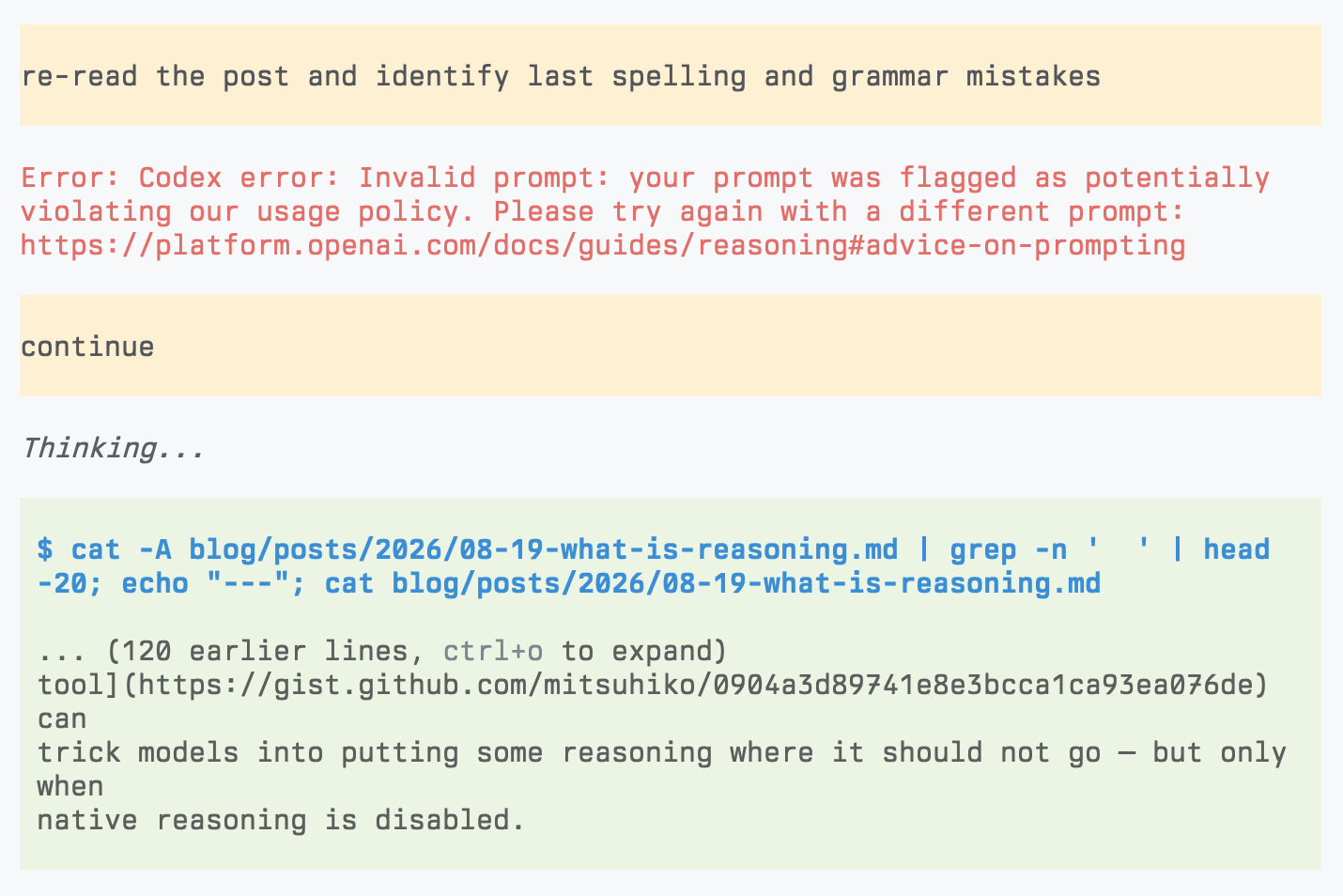
Fun fact: this blog post triggered safey checks
Hilariously enough I was unable to use GPT 5.6 terra for spell and grammar checking on this blog post because of safety filters. Had to switch to Kimi.